Density & buoyancy
The lighter microfoam rose and the heavier coffee sank — which is why the white settles on top instead of mixing in.1Live Science · 2016How Does Latte Art Work?Popular article
Emergence in a Cup
Nobody draws it. It draws itself.
A barista decides only a few things — where to pour, how fast, how high, at what angle. They never place a single bubble. Yet a heart, a rosetta, a tulip appears. The pattern organizes itself out of simple physics.1Wikipedia · 2025Latte artReputable source2Nature Communications · 2017Laboratory layered lattePeer-reviewed study
This is emergence: simple local rules, followed by countless tiny parts, adding up to a pattern far more complex than any one of them. Scroll down and we'll build the idea one cup at a time — then you'll pour your own.
A Short History
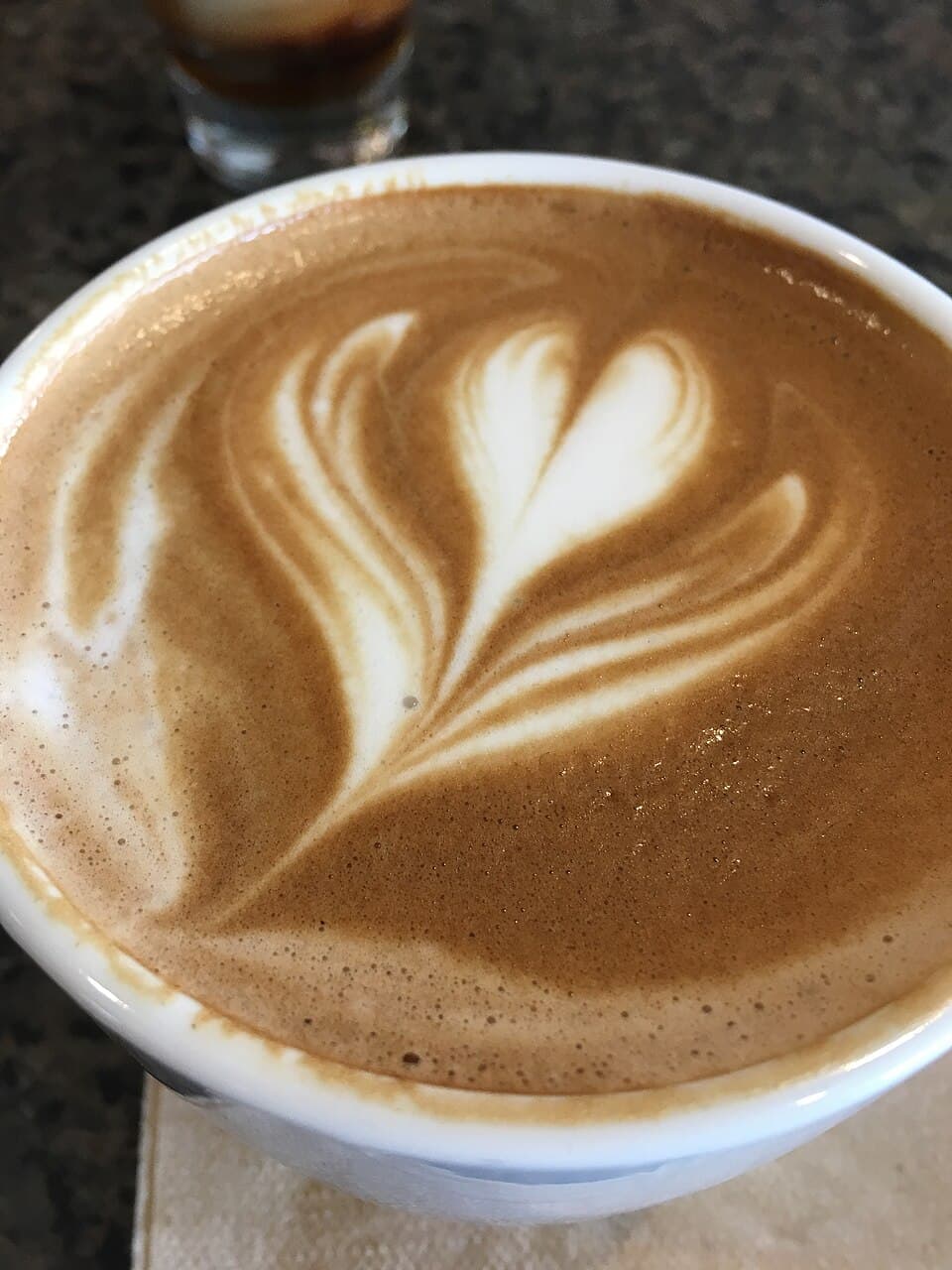
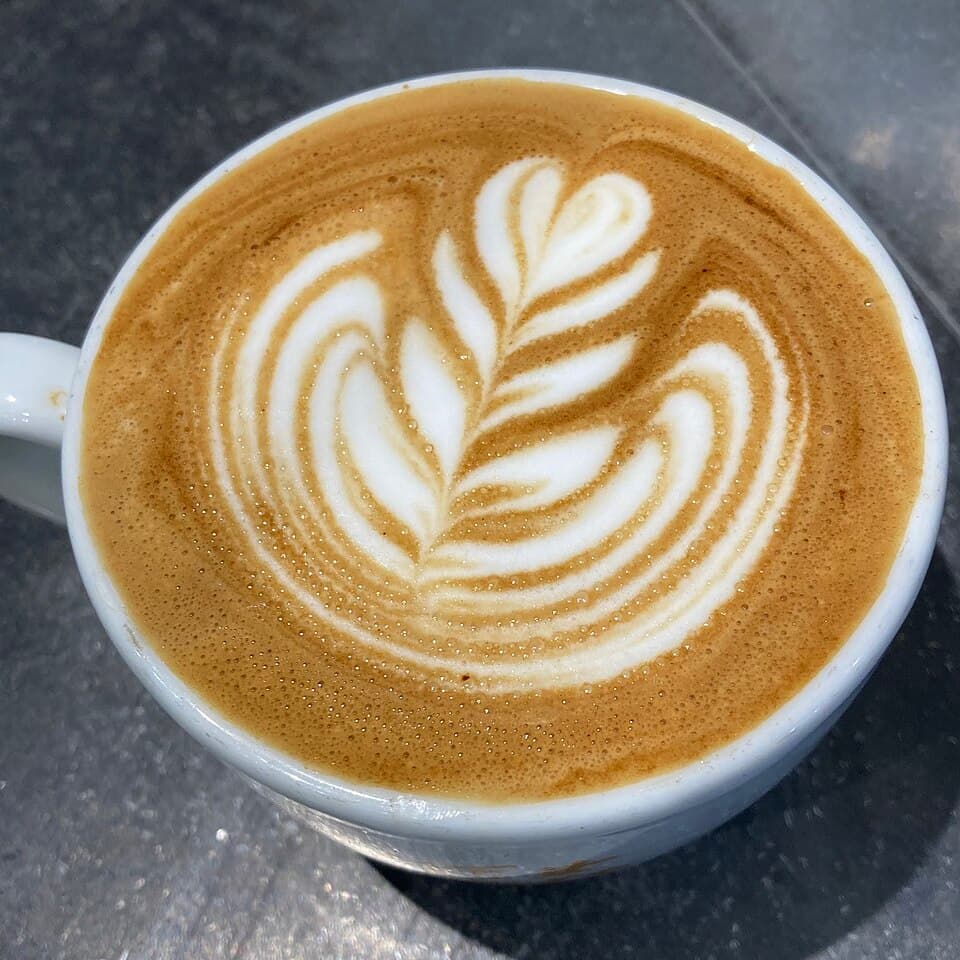
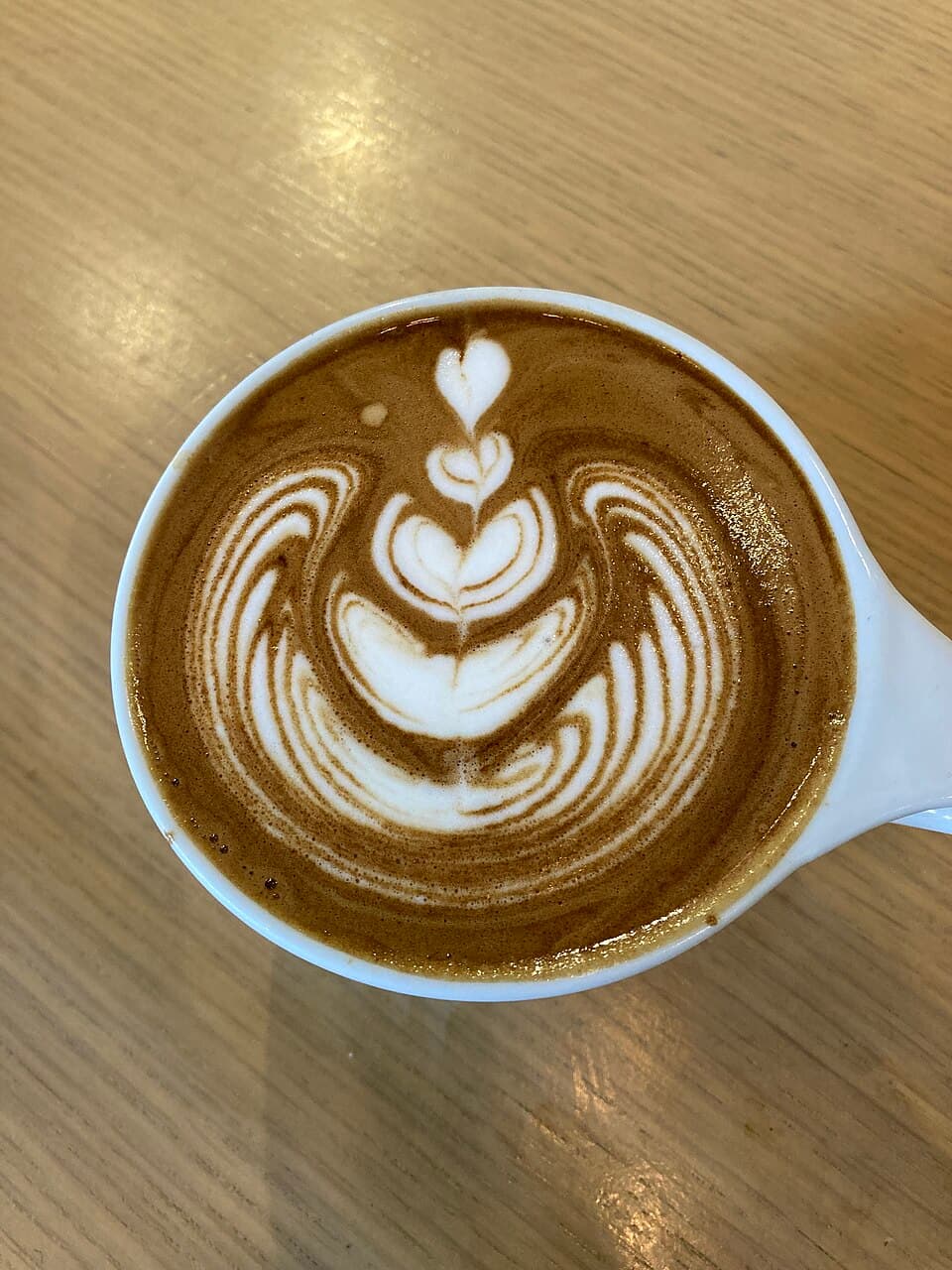
Latte art is only a few decades old. It appeared once espresso machines could whip milk into silky “microfoam,” independently in Italy and in Seattle in the 1980s and ’90s.1Wikipedia · 2025Latte artReputable source
In Seattle, David Schomer made it famous — the heart was his signature by 1989, and he worked out the rosetta in 1992 from a photo he saw at an Italian café. In Italy, Luigi Lupi spread it through instructional videos; the two later collaborated across the Atlantic.1Wikipedia · 2025Latte artReputable source
The Micro Level
Thousands of tiny parts, each obeying the same simple rules.
An agent is just a simple individual that follows its own local rules, with no view of the whole. Zoom in and a latte is a crowd of them: microfoam — milk steamed into countless tiny, even bubbles held together by milk proteins — floating on espresso topped with crema, a foam of coffee oils, gas, and tiny coffee particles.1Live Science · 2016How Does Latte Art Work?Popular article2Wikipedia · 2025Latte artReputable source
No agent can see the whole cup. Each just follows its rules: float if you're lighter than your surroundings, sink if you're heavier, and hold your neighbors with surface tension.1Live Science · 2016How Does Latte Art Work?Popular article
Every particle you just watched obeys the same simple rules:
The lighter microfoam rose and the heavier coffee sank — which is why the white settles on top instead of mixing in.1Live Science · 2016How Does Latte Art Work?Popular article
Watch the foam: its films pull on each other, so it gathers into one connected skin rather than scattered specks.1Live Science · 2016How Does Latte Art Work?Popular article
No particle could see the whole cup. Each reacted only to its neighbors — there was no master plan, and that's the whole point.
The Macro Level
Local rules, repeated a million times, become a shape.
Take the rules from the last section — float, sink, hold your neighbors — and run them across the millions of foam bubbles in a single pour. Out of that, a shape builds itself: the white-on-brown contrast gathers into a heart, a rosetta, a tulip that nobody drew. No single bubble knows it's part of a heart; the shape is simply what a million tiny float-and-spread decisions add up to.1Wikipedia · 2025Latte artReputable source2Nature Communications · 2017Laboratory layered lattePeer-reviewed study
Why does it hold a clean edge instead of smearing? Even the smoothness is emergent. Zoom in and every parcel of liquid follows one local rule: drag along with the parcels touching you. Pour gently and that rule wins — the liquid moves in calm, parallel sheets that slide past each other instead of mixing, so a clean edge can form. That ordered flow, built from countless parcels each just matching their neighbors, is laminar flow. Pour too hard and momentum overwhelms the rule: the sheets curl into churning eddies and the edge smears. Same local rule, same pour-speed knob — it just tips from order into chaos.
Every parcel follows one rule — drag along with your neighbours. Pour gently and that rule wins (smooth, separate sheets); pour hard and momentum overwhelms it (churning, mixing). Same rule, different knob.
So if the rules are always the same, what decides which shape you get? The very first instant of the pour. Tiny differences get amplified as the shape assembles: a hair's difference in where, how fast, or how high the milk goes in is the gap between a crisp rosetta and a muddy blob. The shape isn't drawn; it's set in motion, and the opening moment chooses which one grows.1Nature Communications · 2017Laboratory layered lattePeer-reviewed study
Two pours following the exact same rules, differing only by where they start — just 2.0% of the cup apart. Watch them end up nowhere near each other.
Shapes don't only form across the surface — they can build downward through the cup too. Pour warm milk into espresso fast enough and, instead of blending, it settles into clean horizontal stripes: a layered latte. The local rule is still simple — every bit of liquid sinks or rises to the level that matches its own weight. No single drop is trying to build a stripe, but let every drop do that at once and the whole glass sorts itself top to bottom.1Nature Communications · 2017Laboratory layered lattePeer-reviewed study2Journal of Fluid Mechanics · 2020Café latte: spontaneous layer formation in laterally cooled double diffusive convectionPeer-reviewed study
The cool walls of the glass finish the job, chilling the edges so the sorted bands lock into place and hold for minutes. Princeton researchers identified this self-stacking as double-diffusive convection — the same pattern-building at work in oceans and stars.1Nature Communications · 2017Laboratory layered lattePeer-reviewed study2Journal of Fluid Mechanics · 2020Café latte: spontaneous layer formation in laterally cooled double diffusive convectionPeer-reviewed study3Princeton University · 2017Coffee physics: Layering café lattes yields insights for engineering, medicine and beyondPrimary source4Smithsonian Magazine · 2017The Physics Behind the Layers in Your LatteReputable source
Same rule everywhere — each parcel just settles to its own density. Pour fast and the glass stacks itself into clean layers; pour slow and it blends.
Four facets of one shape-building engine — each is the same story: simple local rules, repeated, assembling structure.
Floating, sinking, and spreading are dead simple. Run them across millions of bubbles and a detailed shape builds itself.1Wikipedia · 2025Latte artReputable source2Nature Communications · 2017Laboratory layered lattePeer-reviewed study
Laminar flow is itself emergent: each parcel just drags along with its neighbors, and a gentle pour lets that local rule win — so the liquid moves in smooth, separate sheets and a crisp edge survives. Pour too hard and it tips into churning turbulence. (A helpful picture, not a precise measurement.)
The rules stay fixed, but the opening instant of the pour decides which shape grows: a minuscule nudge at the start can build a completely different picture at the end.1Nature Communications · 2017Laboratory layered lattePeer-reviewed study
Every parcel of liquid seeks the level that matches its own density; repeat that across the whole glass and it sorts into layers, which the cool walls then lock into crisp, stable bands — the same physics that layers oceans and stars.1Nature Communications · 2017Laboratory layered lattePeer-reviewed study2Journal of Fluid Mechanics · 2020Café latte: spontaneous layer formation in laterally cooled double diffusive convectionPeer-reviewed study3Princeton University · 2017Coffee physics: Layering café lattes yields insights for engineering, medicine and beyondPrimary source
The Latte Art Simulator
Change the rules. Watch the pattern change with them.
This is a real fluid simulation. You set the initial conditions — pour height, speed, angle, flow rate, milk temperature — and the pattern emerges from the physics, not from a script. Pour slowly and it blends; pour faster and structure appears, just as the research describes.1Nature Communications · 2017Laboratory layered lattePeer-reviewed study2Smithsonian Magazine · 2017The Physics Behind the Layers in Your LatteReputable source
Drag on the cup to pour
Low draws a pattern on top; high sinks in and fills the cup
How fast the stream hits — tiny changes here send the pattern in wildly different directions
Tilt of the cup — the pattern leans the way you lean
How much milk pours at once — a thin stream layers, a thick one mixes
Cooler milk is thicker and sluggish; warmer milk is looser and spreads
Extra curl in the flow
Crispness of the rosetta petals
How opaque the milk foam reads
Wet-foam highlight
What You Just Learned
Everything you just poured came from one idea: simple local rules — float, sink, spread — repeated across millions of tiny parts until a pattern no one drew appears. In the simulator you set only the initial conditions; the shape emerged from the physics, not from a script.1Wikipedia · 2025Latte artReputable source2Nature Communications · 2017Laboratory layered lattePeer-reviewed study
That's emergence. No single bubble was trying to make something beautiful — each just did its one small job, blind to the whole. That's nature's quiet habit, from a cup to the oceans and the stars: let many small parts each follow simple rules, and a beauty no one could have drawn appears on its own.1Nature Communications · 2017Laboratory layered lattePeer-reviewed study2Princeton University · 2017Coffee physics: Layering café lattes yields insights for engineering, medicine and beyondPrimary source3Smithsonian Magazine · 2017The Physics Behind the Layers in Your LatteReputable source